
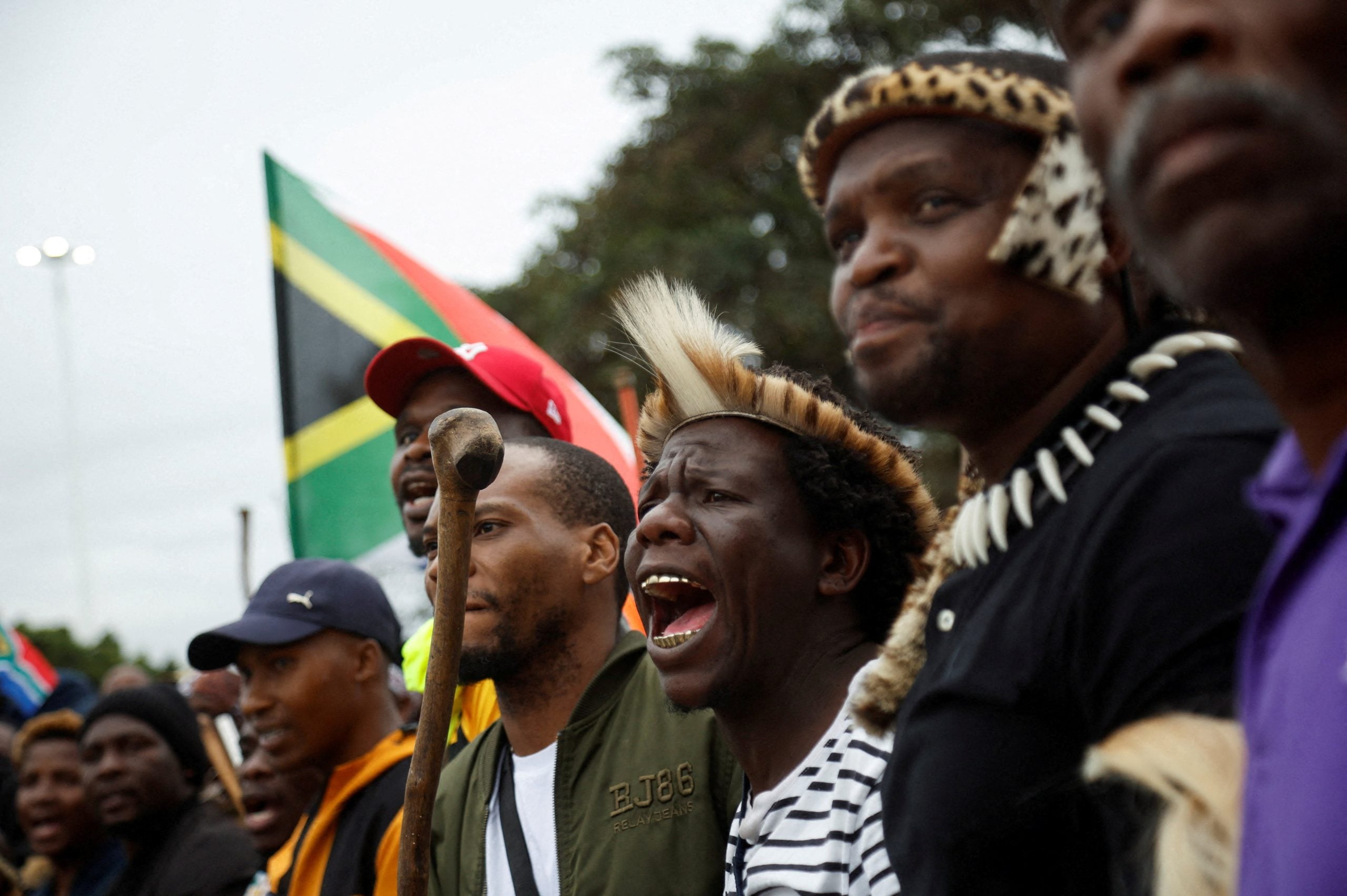
South Africans are pointing their anger at the people in front of them: street traders, domestic workers, informal labourers, shopkeepers and desperate jobseekers. Migrants are treated as if they woke up one morning and decided to invade South Africa.
There is a deeper culprit: a regional economic order that has enriched South Africa while weakening the productive capacity of its neighbours.
South Africa has spent decades turning neighbouring African countries into consumer markets for its finished goods – it should not be surprised when the children of those consumer markets eventually follow the factories, banks, shops, mines, farms, supermarkets and logistics systems into South Africa.
A trade relationship born in white-minority power
On 30 November 1964, apartheid South Africa concluded a trade agreement with Southern Rhodesia (present-day Zimbabwe), which came into force on 1 December 1964. It provided preferential rates of duty, rebates and quotas on certain goods traded between the two economies.
It wasn’t reviewed until 1996, under democratic South Africa, and ended in November 2018, because the wider Southern African Development Community (SADC) Free Trade Area made it irrelevant. South Africa’s economic relationship with Zimbabwe did not begin with pan-African solidarity. It began as an arrangement between two white-minority systems, designed to protect trade and industrial interests.
READ MORE Why Zimbabwe permits still haunt South African politicsAfter 1994, democratic South Africa had the chance to forge an industrial partnership with Zimbabwe. It could have supported joint manufacturing, agro-processing, engineering capacity, railway rehabilitation, energy security, pharmaceutical production, mineral beneficiation and regional value chains.
Instead, Zimbabwe increasingly became a market, a labour reserve and then a political inconvenience to be managed.
The $30bn imbalance
In 2023, South Africa’s total trade with the rest of Africa was about $39bn. This included about $30bn in exports from South Africa to other African countries, and $9bn in imports from Africa into South Africa.
A relationship of regional economic dominance
In 2024, the same pattern continued. South Africa’s exports to Africa rose slightly to about $31.2bn, while imports from Africa increased to about $10.7bn. This means trade with Africa rose to roughly $41.9bn.
READ MORE Immigrants from South Africa’s neighbours send home billions of rands. Here’s the top 10But the imbalance remains. It is also a relationship of regional economic dominance.
South Africa wants African markets, not African people
South Africa’s exports to Africa are industrial and processed: mineral products, vehicles, machinery, processed foods, beverages, chemicals and other consumer goods. Africa buys from South Africa products that create factory employment, logistics networks, banking profits, transport demand and industrial capacity inside South Africa.
This is the core contradiction. South Africa wants African markets for its manufactured products but gets angry when Africans from those markets arrive looking for work.
READ MORE Jacinta Ngobese-Zuma, the face of South Africa’s anti-immigrant protestsSouth Africa wants Zimbabweans, Mozambicans, Malawians, Basotho, Namibians, Zambians, Nigerians and Congolese to buy its food, fuel, building materials, vehicles, banking products, insurance, retail goods and manufactured inputs. But it does not want to face the consequences of a regional economy where production is concentrated in South Africa and surrounding economies are reduced to consumption.
According to World Bank data, exports of goods and services represented about 31.85% of South Africa’s GDP in 2024.
Free South Africa, stronger corporate South Africa
South African corporate power is benefiting more under a free South Africa than it did under apartheid – with the help of Black-majority governments that speak the language of pan-African solidarity.
The South African government gains through corporate income tax on profitable exporters, Pay As You Earn (PAYE) from workers in export industries, port and logistics revenues and the entire local value chain that produces the exported goods.
READ MORE Pan-African banking: Where do domestic banks fit in the new financial order?South African companies pay corporate tax at 27% on taxable income. There may be no single published line called “tax from exports to Africa” – but African markets sustain South African taxable profits and industrial employment. The migrant crisis cannot be separated from regional economics.
Migration follows economic gravity
South Africa’s 2022 census counted more than 2.4 million migrants, just under 4% of the population.
READ MORE Nigeria accuses South Africa of ‘complicity’ in xenophobic violenceYet migrants are blamed for unemployment, crime and service delivery failure. But South Africa’s problems are structural: inequality, corruption, poor municipal governance, deindustrialisation in some domestic sectors, weak growth, energy failures, and a regional economy that South Africa dominates.
Zimbabwe must also face the mirror
Zimbabweans must also be honest. ZANU-PF’s governance failures, corruption, violence, policy inconsistency, land disruption without adequate production support, currency collapse and repression have devastated a country that had one of Africa’s strongest industrial bases.
Since 1994, successive South African governments have preferred quiet diplomacy, liberation-movement solidarity and political accommodation instead of insisting on democratic renewal and economic reconstruction.
READ MORE ANC endorsing Zimbabwe’s flawed election fuels South Africa’s xenophobiaIt has sustained ZANU-PF’s survival as Zimbabwe’s productive base deteriorated and millions of Zimbabweans searched for survival elsewhere.
Corporate expansion is not industrial solidarity
The question must be asked plainly: since Nelson Mandela became president in 1994, what substantial, state-backed industrial joint venture has South Africa carried out with any African neighbour to transform that country’s productive capacity?
There are South African corporate expansions across Africa: banks, supermarkets, mobile operators, construction firms, insurers, logistics companies and retailers. But that is not solidarity.
READ MORE US industry lobbies for South Africa and Ethiopia to stay in crucial trade dealReal industrial solidarity would mean working towards joint factories, as well as technology and skills transfer. Deliberate efforts to build productive capacity outside South Africa would include concessional industrial finance, local procurement, railway rehabilitation, energy interconnection and mineral beneficiation.
The1964 structure still lives
The underlying structure of the 1964 agreement remains. South Africa sits at the region’s industrial centre: its neighbours are expected to provide markets, minerals, labour and political loyalty.
READ MORE South Africa, Zimbabwe secondary exchanges open deeper African marketsSADC’s language exposes the problem. The SADC Free Trade Area was meant to liberalise trade, promote investment, diversify economies and support industrialisation. But liberalisation between unequal economies doesn’t automatically create shared prosperity: it often strengthens the strongest.
What Africa must learn
African countries must stop confusing South African corporate expansion with pan-African solidarity. African countries must stop accepting finished-product dependency as integration.
Countries such as Zimbabwe must rebuild productive capacity. A country that imports what it can produce is exporting jobs, skills and then its children.
READ MORE A chance of renewal for pan-African organisationsAfrica must use trade policy strategically. Not blind protectionism but rules of origin, local-content requirements, procurement for local firms, regional development banks and time-bound protection for key sectors.
The migrant is the evidence, not the cause
African migrants are not the cause of South Africa’s crisis. They are evidence of a regional malaise: evidence that Southern Africa has imbalanced industrial development.
South Africa’s post-apartheid foreign policy has spoken of liberation while practising the economics of dominance. The finger is pointing in the wrong direction. The real question is not why Zimbabweans, Mozambicans, Malawians, Basotho, Congolese or Nigerians are in South Africa.
READ MORE South Africa’s immigration debate: Are most citizens xenophobic?The real question is why African economies have been allowed to collapse into consumer markets while one country presents itself as the factory, the banker, the retailer and the gatekeeper of the region.
Until Africa confronts that structure, the violence will repeat itself. The victims will be migrants. The beneficiaries will be political opportunists. And the real culprits – the barons feeding on an unequal regional economy dressed up as integration – will escape accountability.
Viewpoint Africa South Africa Zimbabwe Politics Politics news advertisementTop Stories
-
giants outbid
Tony Elumelu’s Heirs Energies and state giant NNPC lose oil block bids to little-known firms -
come together
TPLF’s rhetoric and Ethiopia’s reality on the ground: When politics forgets people -
regional ambitions
Can Dangote pull it off? 5 questions over Kenya’s $17bn refinery -
Father may I
10 things about Cameroon’s first son, Franck Biya -
concrete competition
Nigeria: In Huaxin, Dangote and BUA face a rival powered by Hong Kong capital
Politics

Politics
Ballot blitz
Zambia: How adversity united the opposition three months before the election

Politics
clutching straws
Macky Sall and Olara Otunnu’s bids for the UN: how the crucial secret ballot stage will unfold

Politics
grayscale
Is the ICC too focused on Africa?
Politics
vacant lot