
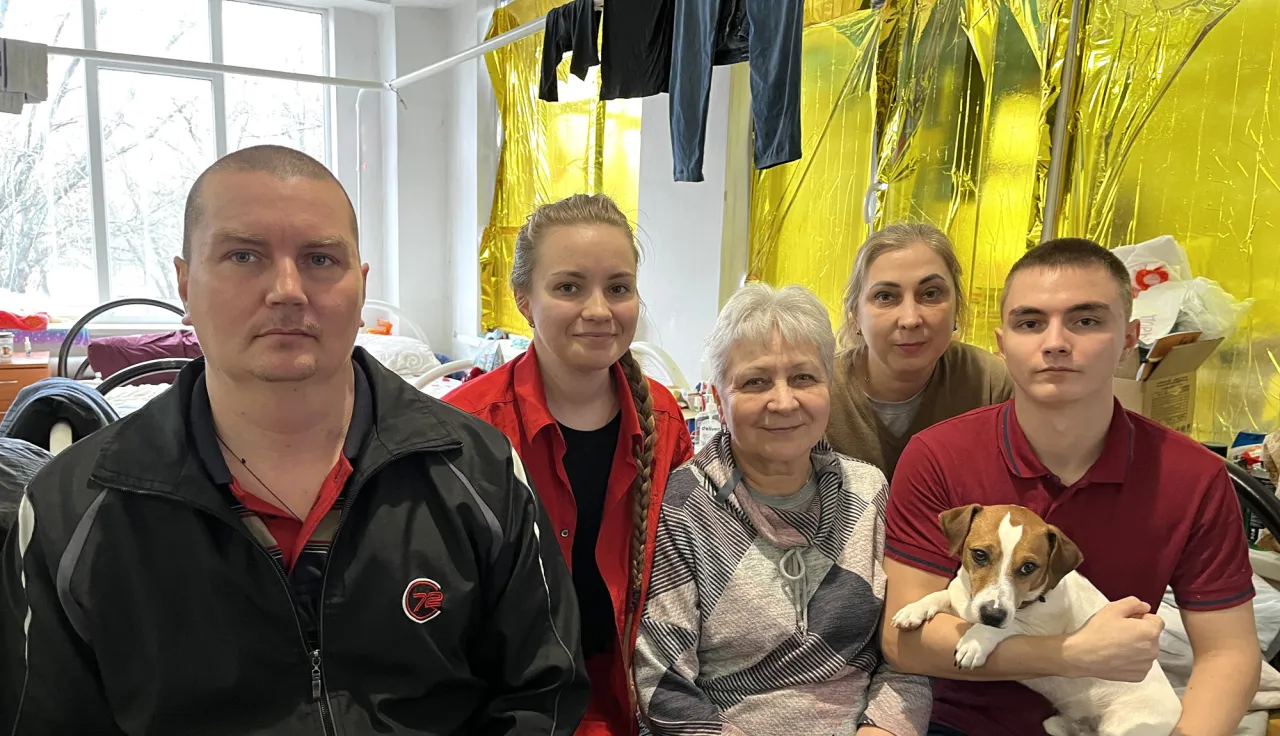
For years, communities across Donetsk region have lived under the shadow of intensifying hostilities. In towns like Kurakhove and Pokrovsk, previously ordinary routines such as fishing, going to work and raising a family have been transformed by shelling, drone strikes and displacement.
Behind every statistic on displacement is a person who made a difficult choice about how to survive the hostilities: to shelter underground, to flee at the last possible moment, to carry a loved one out on their back.
The ICRC and its operational partner strive to help communities in need by delivering humanitarian aid and support people separated from their families.
These are some of their stories.
He Built a Shelter. A Stranger Carried Him Out
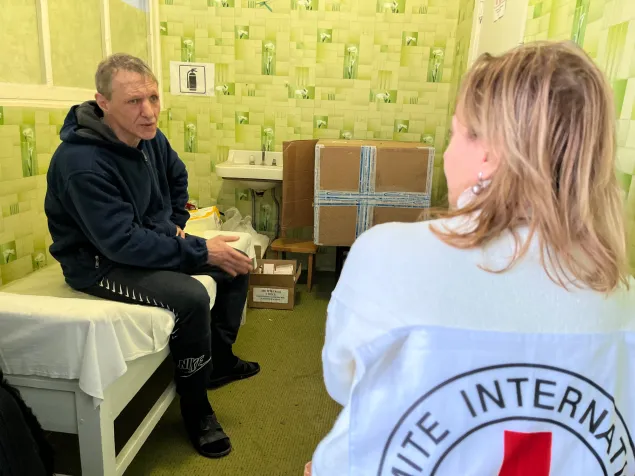 Sergey, Rozdolne village, near Kurakhove, 2026 @ICRC Sergey, Rozdolne village, near Kurakhove, 2026 @ICRC
 Sergey reinforced his own basement with concrete slabs and makeshift beds, anticipating what was coming. When the shelling intensified, he moved his wife and adult son underground. Both are blind from birth and entirely dependent on him. He became their eyes, fetching water and food, baking flatbread when there was no more bread to be found. When a young man in the village lost his home, Sergey took him in too.
That decision saved his life. Two and a half months later, a drone struck the basement directly. Blinded by blood and smoke, unable to move, Sergey was carried out by the same young man he had sheltered, who then went back for his wife and again for his son.
Everyone survived. Sergey's home did not. Communities like his continue to receive support from the ICRC and its operational partner, which works to reach people in the most isolated and heavily damaged areas. Today, Sergey's dream is modest and specific: a small house near his home area, some poultry, a garden, "a few rows of radishes... like everyone else."
Eight People, One Basement, and the Will to Survive
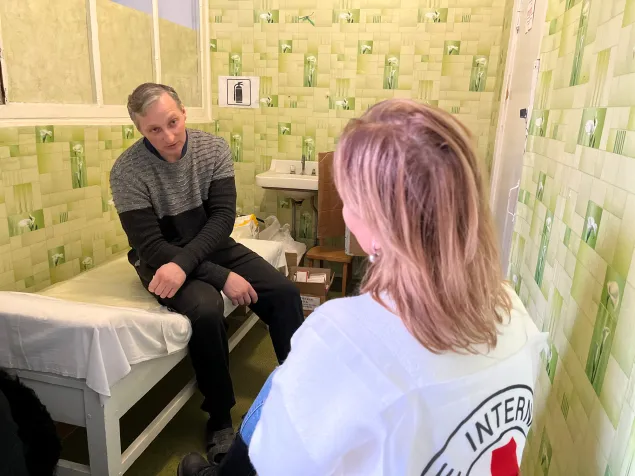 Eduard, Kurakhove, 2026 @ICRC Eduard, Kurakhove, 2026 @ICRC
 Before the fighting reached his town, Eduard spent his days fixing bicycles, chainsaws and brush cutters, machines other people depended on. When the hostilities came, he and seven neighbours took shelter in a basement reinforced with railway tracks, a detail that would ultimately save their lives.
For three months, as drones hummed overhead and explosions shook the ground so hard that dust rose almost a metre high inside their shelter, the group survived on what they had prepared in advance. "Before the fighting got really bad, we'd received humanitarian aid from the Red Cross," Eduard recalls. "We brought everything down ahead of time: food, medicine. That's what got us through."
Eduard and his neighbours were eventually evacuated. Their survival was built on preparation, community and humanitarian assistance that reached them just before the door to the outside world closed.
The Wheelbarrow and the Road Out
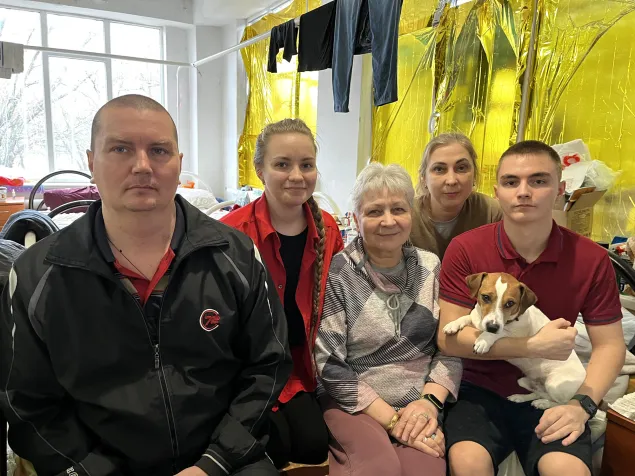 Daniil, Pokrovsk area, 2026 @ICRC Daniil, Pokrovsk area, 2026 @ICRC
 It was after midnight when the ceiling came down. A drone strike collapsed part of Daniil's home, pinning his leg beneath the rubble. His parents freed him, and in the chaos that followed the family, Daniil, his parents, his twin sister, his grandmother made the decision to leave at first light.
Before they fled, Daniil's mother ran upstairs one last time, not for valuables but for clean clothes. "We couldn't go out in dirty clothes," she says, holding on to a small piece of dignity in the middle of catastrophe. Daniil's father then pushed him in a wheelbarrow for four kilometres through a city reduced to rubble, navigating around mines scattered along the road, until they reached medical help.
The family was separated during evacuation. Daniil’s mother accompanied him to hospital while the rest of the family ended up in different temporary accommodation. "I thought I would lose my mind until we were all together again," his mother says. "We've lost everything," she adds quietly. "We'll have to start from scratch. But the most important thing is that we're alive and together."
Support from the ICRC and its operational partner has played a role in Daniil’s recovery, forming part of a larger initiative to help people displaced by the conflict rebuild not just their physical health, but also their sense of purpose.
The Architect Who Built Hope from Cardboard
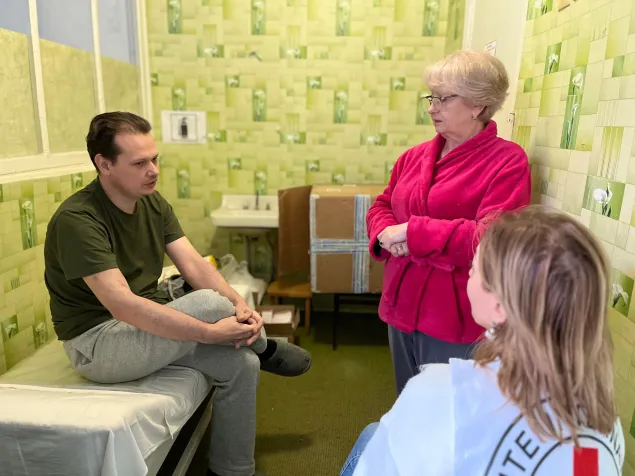 Aleksandr, Pokrovsk area, 2026 @ICRC Aleksandr, Pokrovsk area, 2026 @ICRC
 Aleksandr spent his career designing the buildings, residential towers, clinics, supermarkets of his city that thousands of people walked through without ever knowing his name. Then, in a parking lot, a drone struck , and glass tore into his face and legs. With no functioning medical services left in the city, his mother Zhanna removed what glass she could reach with a pair of tweezers.
For six months, the family sheltered in a single room in a neighbour's country house, living on canned food and well water. In that room, Aleksandr began building a model house out of cardboard, windows cut from plastic bottles, a roof laid in toothpicks, the same precision he once brought to his blueprints.
When evacuation finally came, Aleksandr walked once more through the city he had helped design, now in ruins.
The ICRC and its operational partner work hard to reach communities like this providing support to those enduring challenging conditions - isolated, injured and struggling to survive with what little they have left. Aleksandr still carries the blueprint of his real dream home somewhere inside him, waiting for the chance to build it.
I Still Have My Hands
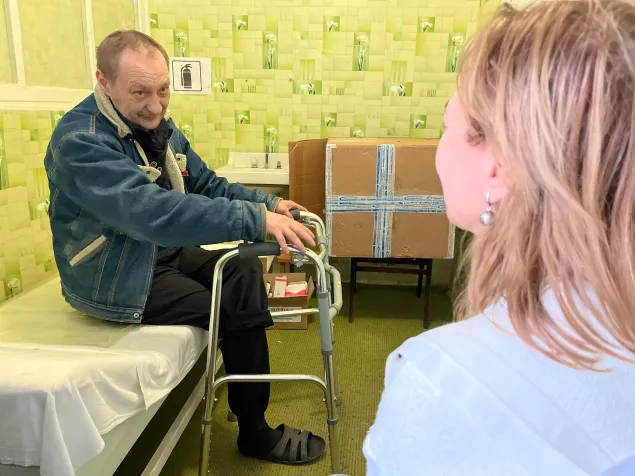 Sergey, Kurakhove area, 2026 @ICRC Sergey, Kurakhove area, 2026 @ICRC
 Sergey learned patience as a boy, standing beside a reservoir with his grandfather, sorting fishing nets and waiting for the right catch. It was a lesson in stillness that he carried with him for the rest of his life, until shelling struck the yard of his home and he lost his leg.
Now living in temporary accommodation far from the water he grew up by, Sergey is on the long road of rehabilitation. People from his village still call him, telling him the nets need sorting, that there is no one left to fish. "It feels like my soul is pulling me there," he says. But even from a distance, he holds on to a quiet certainty: "I still have my hands. That means everything will be alright."
Support from the ICRC and its operational partner have been part of Sergey's recovery, one part of a broader effort to help people displaced by the conflict rebuild not only their bodies, but their sense of purpose.
Each of these stories is different, but they share the same thread: communities enduring the unimaginable and finding ways to survive – through preparation, helping each other and small acts of dignity. The ICRC continues to work alongside people across Donetsk region and the wider conflict-affected areas, providing humanitarian assistance, supporting family reunification and assisting communities grappling with displacement and the long road of recovery that follows.
Related
 Article 30-07-2026
 ICRC holds exhibition in Seoul to mark the 60th anniversary of Republic of Korea’s accession to the Geneva Conventions
 Article 29-07-2026
 Frequently asked questions about the ICRC’s work in Yemen
 Legal factsheet 29-07-2026